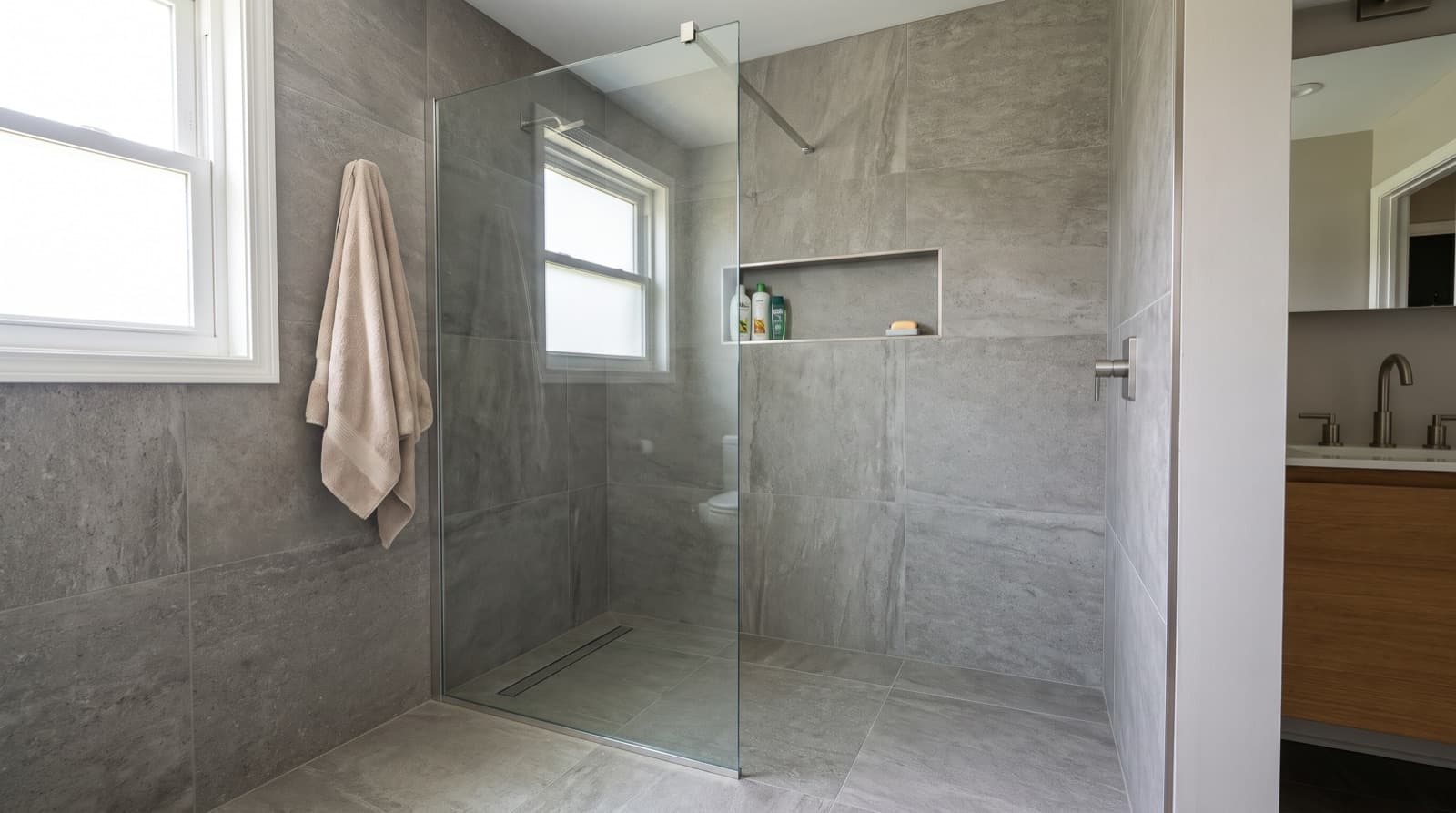
What glass shower enclosures are and how they work
An enclosure is any combination of fixed glass and doors that closes in a shower. Common layouts:
- Single fixed panel. One glass shower panel that blocks the spray, with an open entry. Often called a walk in shower glass panel.
- Inline panel and door. A fixed panel next to a hinged door across a straight opening.
- Corner enclosure. Two glass walls meeting at a corner, with a door on one side.
- Neo-angle. A five-sided corner shower where the door sits on an angled front between two short panels.
Fixed panels are held by clips, U-channel or a low-profile track at the base and wall, and many tall panels use a support bar to the wall or ceiling.
When panels are the smart call (and when they aren't)
A fixed glass shower panel makes sense when:
- You are building a walk-in shower with a large, curbless or low-curb entry.
- You want the most open look and the fewest moving parts. No hinges means less to adjust.
- A corner shower needs custom-cut glass to fit walls that are not square.
It may not be the right call when:
- The shower is small. An open panel lets more spray and warm air out, so a door may be more comfortable.
- The entry would be too tight. The International Residential Code calls for a clear, unobstructed finished opening of at least 22 inches into a shower.
Options: layout, glass and hardware
Neo angle shower door units. Good for corner showers in older bathrooms. They can be framed or frameless. Replacing a framed neo-angle with frameless glass is a common upgrade.
Glass thickness. Frameless panels typically use 3/8 inch to 1/2 inch tempered glass. Thicker glass is heavier and may need more support.
Glass type. Clear, low-iron, frosted or patterned. This Old House prices low-iron glass at about $6 to $15 extra per square foot and frosted at about $2 to $11 extra.
Hardware. Clips or channel, a support bar, and a door if you have one, in chrome, brushed nickel, matte black or brass tones.
All shower glass has to be safety glass. Under the model building code, glass in a shower enclosure with a bottom edge under 60 inches above the standing surface is a hazardous location.
The Cincinnati factor: corner showers and hard water
A lot of suburban housing is newer than the city core. Census data puts the median year built at 1978 for the middle zip code in the metro, 1976 in 45242 (Blue Ash) and 1990 in 45069 (West Chester). Homes from those years often have a framed neo-angle or corner unit in the primary bath, which is a natural candidate for custom glass.
Hard water matters most on big glass. Greater Cincinnati Water Works reports plant averages of roughly 7 to 8 grains per gallon (approximate, per Culligan). Large fixed panels show spots quickly, so a water-spot coating (about $4 to $20 per square foot per This Old House) and a squeegee are worth planning for.
How a panel install goes
Custom panels start with a measuring visit, because each panel is ordered to the exact size of the opening. The installer checks the curb or floor for level and the walls for plumb, then orders the glass.
On install day, channel or clips are fastened to the wall and curb, panels are set and braced, and any door is hung and sealed. This Old House notes installers typically charge $50 to $100 per hour, and standard installations take two to four hours. Large panels and corner units can take longer.
What to have ready when you call
- Photos of the shower area from the doorway and from inside, plus the curb or floor where the glass will sit.
- Rough width of each side and the height you want.
- Whether it is new construction, a remodel in progress, or a replacement of existing glass.
- Your layout idea: fixed panel, panel and door, corner or neo-angle.
- Hardware finish and glass type.
For a remodel, it helps to call before the tile is finished so the installer can advise on backing for hinges and clips.
Common questions
How much do glass shower enclosures cost?+
Inch Calculator lists a stock 30 by 30 inch enclosure at $400 to $2,000, plus $350 to $1,000 to install. It says custom enclosures start around $5,000 installed. A local installer can quote your layout after measuring.
How much does a neo-angle shower door cost?+
Inch Calculator puts curved and neo-angle doors at a minimum of about $900 to $2,000, rising from there. Fixr lists neo-angle units at $1,500 to $3,500 in material cost.
Do I need a door, or is a fixed panel enough?+
A single fixed panel works well for a larger walk-in shower where the spray points away from the opening. In a smaller shower, a door keeps water and warmth in. Send photos and the installer can suggest a layout.
Which glass is best for a shower panel?+
Tempered safety glass, typically 3/8 inch for frameless panels, with 1/2 inch for a heavier feel. Low-iron glass looks clearer at the edges, and a water-spot coating helps with Cincinnati's hard water.
Is 24 too narrow for a shower opening?+
It meets the code minimum. The International Residential Code calls for at least 22 inches of clear, unobstructed finished opening. A wider entry is more comfortable, so ask the installer if your layout allows it.